

This article is an excerpt from the CustomerThink research report Customer Experience at a Crossroads: What Drives CX Success?, based on a study of 200+ CX initiatives in 2018.
While industry experts generally agree that customer experiences include all interactions and the resulting customer perceptions[1], there is more confusion about what Customer Experience Management (CXM) entails. These perceptions were explored with survey respondents, 92% of which were CX team leaders or members.
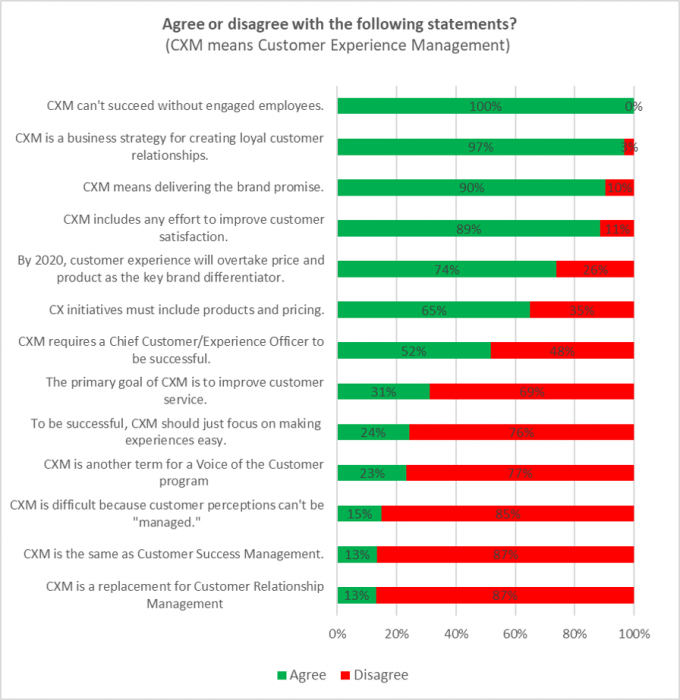
There was emphatic agreement that key elements of CXM include delivering the brand promise and increasing customer satisfaction and loyalty. In this respect, CXM is a new term for loyalty management practices that have existed for decades. Also, everyone agreed that engaged employees were essential to CX success.
In contrast, there was strong disagreement that “CXM is the same as Customer Success Management” (CSM), or that “CXM is a replacement for Customer Relationship Management (CRM)”, or that “CXM is another term for a Voice of the Customer program.”
Most respondents also rejected the notion that CXM is difficult because experiences can’t be “managed” as some have suggested. According to industry analyst Thomas Wieberneit, “ … customer experiences are living in the perception of the customer, and hence are solely managed by the customer, not by any company.”[2]
Of course, CX managers are unlikely to agree that their role is fundamentally flawed because customers are in control! Pragmatically speaking, CXM is not about controlling customer experience, but about making changes that the company can control (processes, employee behaviors, product capabilities, etc.) to influence perceived experiences in a positive direction. While “CX Influence” might be technically a better term, CXM has been widely adopted by the industry, including hundreds of consultancies and a growing number of technology firms.
There were mixed reactions to other statements. One of them gets to the heart of what CX is — and isn’t.
For instance, 74% agreed: “By 2020, customer experience will overtake price and product as the key brand differentiator.” Taken literally, this statement is a logical fallacy. If CX includes all interactions and perceptions, then it must include price and product. CX can’t “overtake” something it includes.
But, CX thought leaders don’t parse it this way.
CX is a representation of everything an organisation does to contribute to the delivery of the “end to end customer experience”.
— Ian Golding, CX consultant
CX (as seen from customers’ eyes) includes product/pricing/interactions plus customers’ behind-the-scenes efforts to select, get and use a solution toward their goals. The behind-the-scenes efforts include integrations throughout select/get/use with emphasis on “use” — integrations with various people, environs, hardware/materials, software, and processes.
— Lynn Hunsaker, ClearAction Continuum
Customer Experience is what wraps around product and price.
— Colin Shaw, Beyond Philosophy
So, when is an organization not practicing CXM? According to market researcher and CX consultant Dave Fish of CuriosityCX, CXM should not include companies that only emphasize one element such as product or price orcustomer service — and ignore the larger narrative of what customers are experiencing on their journey.
Krista Sheridan, a CX leader with 20 years of CX experience at TELUS, agrees (emphasis added):
“Until companies take a broader view, things won’t really improve. There are so many decisions and work done by so many different people and teams and departments leading up to an eventual customer interaction. And if all that work has created a poor product, poor selection process, annoying payment experience, aggravating policies etc. your interactions with customers can only do so much — they can’t undo all those systemic things!”
Given the foregoing, it’s no surprise that 69% disagreed that the “primary goal of CXM is to improve customer service” and 65% agreed that “CX initiatives must include products and pricing.” Still, roughly one-third of respondents see CXM in a more limited perspective than experts advocate.
Furthermore, while CXM may be about “delivering the brand promise,” some brand promises are not compatible with a holistic definition of CXM. Pushing low prices above all else, with little concern for customer satisfaction, is not considered CXM. Ryanair has prospered with such a model, but CX experts are loath to include this as a CX success story.[3] Indeed, no CX initiatives in this study were focused primarily on low prices.
In recent years, spurred by the success of Amazon, many companies have pursued making experiences easy or effortless. In fact, “easy” was the top CX attribute believed to drive customer loyalty, cited by 83% of all respondents. But, 76% disagreed that: “To be successful, CXM should just focus on making experiences easy.” While being “easy” is clearly important, it’s not the only thing that matters. And indeed, it’s not a differentiator for “Winning” CX initiatives, as will be explored later in this report.
Finally, there was nearly an equal split in agreement on whether a Chief Customer/Experience Officer is required for CXM success. This is consistent with prior CustomerThink research that found a slight majority of organizations believed that a Chief Customer Officer (CCO) would be of benefit to the company, to facilitate cross-department coordination and get support from the CEO and Board.[4]
What Does CX and CXM Mean to Your Business?
The implication for CX leaders is…