
Today, social media has become an integral part of our daily lives. Very few of us can go more than a few hours without checking our Instagram, Twitter, or Facebook feeds. Your customers probably fall into the same camp. By using social customer relationship management or CRM, you can harness the power of social media for your small business.
If you’re not too familiar with social CRM, you’ve come to the right place. In this article, we’ll cover the concept in depth. We’ll even share our best social CRM case studies for you to review and replicate for your business.
Table of Contents
What Is Social CRM?
Before we can explain why your company needs this form of CRM, we should begin with a social CRM definition.
Social CRM or SCRM is a branch of customer relationship management software. While you may still use traditional CRM, you also mix in social media metrics gained from platforms like Facebook and Twitter.
The following image illustrates shows how social CRM is different from traditional CRM in which of the following ways?
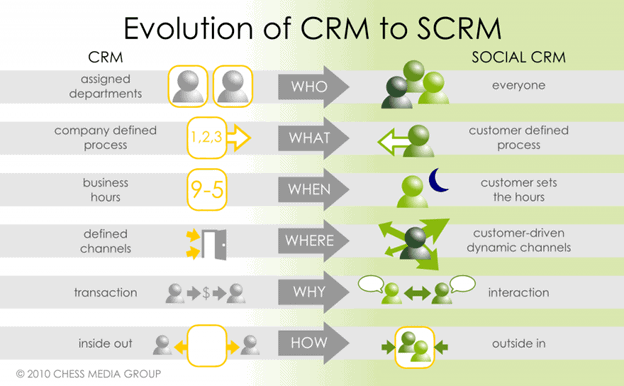
Image courtesy of GetCRM.com
As the graphic shows, CRM often only uses assigned departments while SCRM doesn’t limit its audience base as much. While traditional CRM might have a more defined set of rules that the company comes up with, SCRM relies on its customers for those same rules. Customers even choose the hours, so there’s no predefined nine-to-five here. It’s all about what the customer wants and needs most with SCRM.
CRM relies on more defined channels, but SCRM does not. Instead of always pushing customers to buy, buy, buy, SCRM software and marketing aims for more interaction and communication from the audience, as well as social listening. Many view this as an “outside-in” process rather than one that’s “inside-out,” as traditional CRM is.
The Components of Social CRM
As you begin using social media CRM tool or at least researching one to use, you’ll come across several unique components of SCRM.
Let’s talk more about these components now.
Sentiment Analysis
When you express a sentiment in a conversation, it’s either positive or negative. Having sentiments is part of the human condition, as it allows us to share our thoughts and emotions with others. Social media customer relationship management encompasses the entirety of the customer experience, including a person’s satisfaction or dissatisfaction.
How does a company even begin to figure out their customers’ sentiments? You could comb through all the posts, survey responses, comments, and reviews you’ve ever received on social media, but you’re just one person. It isn’t just possible to single-handedly monitor all of your social media information. After all, you also don’t have all the time in the world.
Social CRM software can show its mettle with sentiment analysis. Using SCRM, you can indeed do the above combing without having to put much human effort towards the job. With sentiment analysis, SCRM software will look through documents, phrases, and words that come up from your customers. If these phrases or words have polarizing connotations, that gets noted as well.
Sentiment analysis is like holding up a magical seashell to your ear to hear the collective voice of your customers. Like most software, it’s not perfect. Sometimes the software can miss irony, metaphors, sarcasm, and nuances that we humans understand. That’s why you’ll have to glance over the results for accuracy. Still, that beats spending hours reading through comment after comment after comment yourself.
Machine Learning
Machine learning might sound scary, but we have to face that it’s our present and even our future. One popular means of machine learning? Artificial intelligence or AI. The algorithms that machine learning studies can predict future trends using current data.
There are two types of machine learning: unsupervised and supervised. Unsupervised machine learning isn’t as risky as it seems, we promise. With this, you’re letting the AI come up with its own trends and analyses without having established a previous data baseline. With supervised machine learning, you use certain data to create that baseline. Both forms of machine learning have their place depending on your current needs.
Text Mining
Text analytics, text data mining, or—more simply—text mining has a similar concept to sentiment analysis. This time, you parse data for the sake of finding mood patterns over the short-term and long-term. It’s less about establishing a customer voice then and more about identifying mood changes.
Do your customers still like your new product or has something happened to sour their perception? Have once-reluctant customers come around and changed their minds? With text mining, you can find out.
Natural Language Processing
Finally, there’s natural language processing. This may sound just like sentiment analysis and text analytics, but it’s different. For instance, natural language processing focuses more on adjectives, verbs, nouns, and other speech. The AI here can read through lots of text at once and even has higher accuracy if the text comes across as random. That’s not nearly as true for sentiment analysis.
Natural language processing works for social media especially well. Why? As mentioned, this form of SCRM has a strong ability to handle and comprehend random text. In fact, the AI can even take into account word omissions, misspellings, and unfamiliar text, all of which are common on social media.
When combined with text mining and sentiment analysis, you can get the feel, voice, and meaning of customer messages on social media using SCRM.